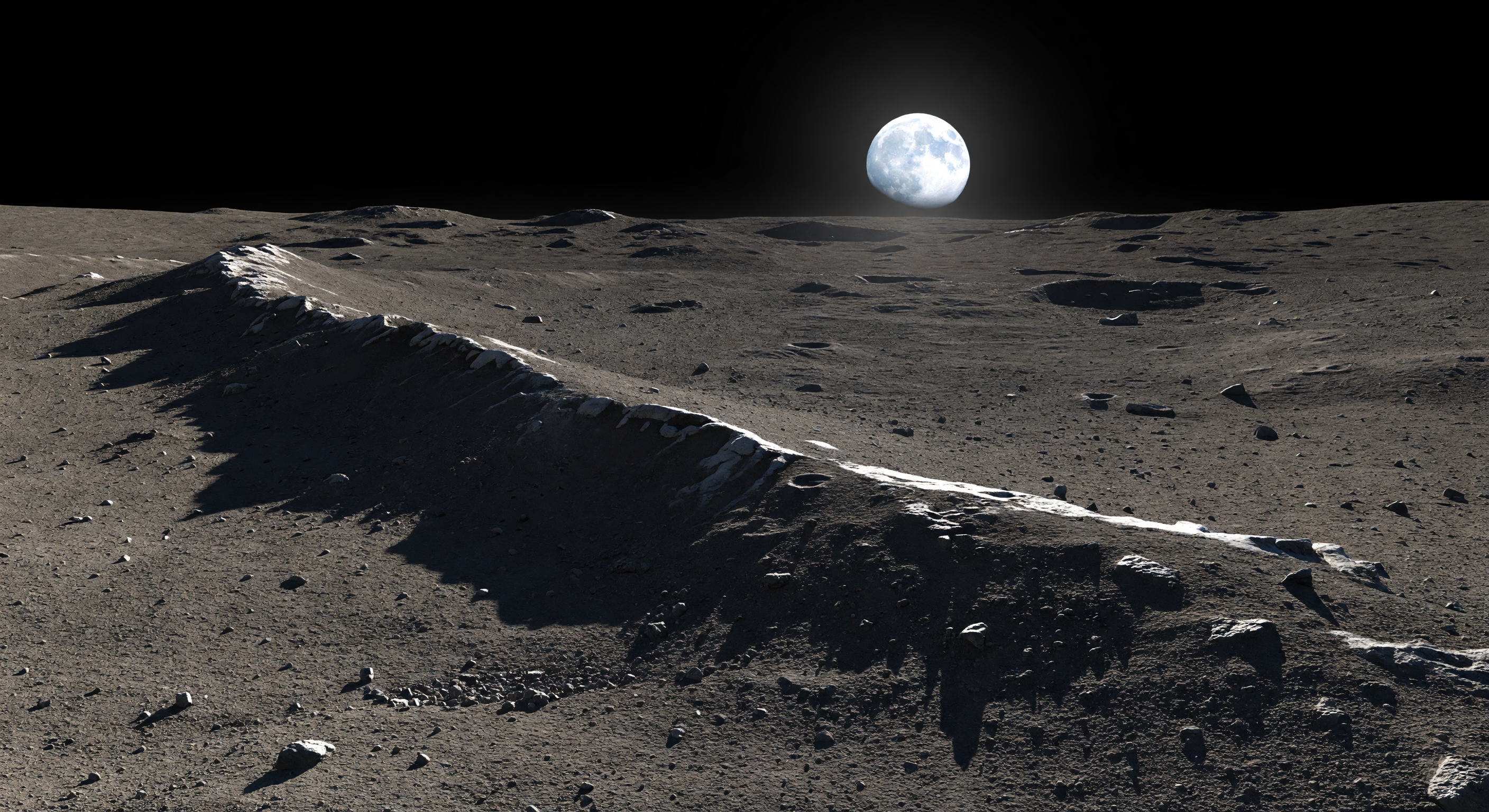
끝없이 펼쳐진 어두운 현무암질 평원 위로, 지평선 가까이 낮게 걸린 태양빛이 굽이치는 주름 능선을 극적으로 떠올려, 한쪽은 급한 단애처럼, 다른 쪽은 완만한 비탈처럼 비대칭적인 윤곽을 또렷이 드러냅니다. 능선의 울퉁불퉁한 마루에는 작은 충돌구와 그 주변의 분출물, 기슭의 각진 암괴들이 얹혀 있어, 이 지형이 식어 굳은 마리아 현무암이 지각 수축으로 압축되며 밀려 올라간 구조지형임을 보여 줍니다. 대기가 전혀 없어 하늘은 완전한 검은색이고, 모든 바위와 crater 림, 능선이 던지는 그림자는 믿기 어려울 만큼 날카롭고 새까맣게 길게 뻗어, 거리감과 높낮이를 더욱 극단적으로 강조합니다. 발아래의 미세한 회색 레골리스 입자에서부터 멀리 희미하게 이어지는 낮은 분화구 테두리까지, 안개 하나 없는 진공의 풍경은 침묵과 거대한 시간을 눈앞에 실체처럼 세워 놓습니다.
과학 심사 위원회
각 이미지는 AI 위원회에 의해 과학적 정확성이 심사됩니다.
GPT
이미지: Adjust
설명: Adjust
Scientific accuracy: The scene convincingly depicts a Moon-like airless environment (high-contrast lighting, rock-sized shadows, no atmospheric haze). The lighting is consistent with low-angle illumination from near the horizon, which helps emphasize a large ridge feature and its asymmetry. However, the depicted “terminator” is not clearly established: the Sun is not shown, the ridge shadows are present but the overall horizon illumination does not read as a precise terminator transition (day/night boundary). Additionally, the prominent Earth appears as a near-perfect blue-white disk without atmospheric tinting/scattering effects that might be expected at this scale; while Earth visibility is plausible, the exact coloration/clarity may be slightly stylized. The ridge looks like a wrinkle ridge or scarps, but the detailed geological attributes cited in the caption (e.g., explicit superposed tiny craters, ejecta aprons, and blocky debris specifically at the base of the ridge in a way that supports the described stratigraphic/impact reworking) are not clearly identifiable at this resolution. Visual quality: The image is largely photorealistic with coherent terrain texturing, plausible basaltic regolith/gravel distribution, and no obvious compositing artifacts. Shadows have directionality and contact shadows that fit the illumination. Minor issues include the overall lack of crisp terminator-horizon cues and some ridge-edge brightness that may be slightly “rendered” rather than strictly physically driven. Caption accuracy: The caption broadly matches what is shown (a long ridge on a dark lunar-like plain, stark shadows, no haze, Earth in the sky). But the caption makes more specific claims about ridge formation details and particular small-crater/ejecta evidence along the ridge base and crest that are not clearly confirmed visually here. Also, the term “Terminator” is not strongly evidenced beyond low-angle light—there is no clear day/night boundary at the horizon. Recommend adjusting the caption to be less specific about unverified small-scale features, or regenerating/retuning the lighting and horizon so the terminator boundary is unambiguous (e.g., show Sun direction or stronger contrast at the horizon).
Claude
이미지: Adjust
설명: Adjust
I largely concur with GPT's assessment but want to add several more specific observations. SCIENTIFIC ACCURACY: The low-angle raking illumination is the image's strongest scientific asset — it correctly creates razor-edged, pitch-black shadows with zero penumbral softening, consistent with an airless environment. The regolith texture, gray-brown basaltic coloration, and scattered boulder distribution are plausible. The wrinkle ridge morphology — asymmetric flanks, a sinuous crest, and a steeper scarp face — is broadly consistent with lunar compressional ridges like those seen in Mare Imbrium or Mare Serenitatis. However, I flag a significant issue GPT underemphasized: the white/bright material along the ridge crest reads visually more like exposed ice or frost than freshly fractured high-albedo anorthosite or impact melt glass. On the Moon, even bright materials (anorthosite, fresh ejecta) do not exhibit this level of whiteness contrast at this scale without specific geological justification that the caption does not provide. This risks implying ice at low latitudes, which is scientifically misleading. The Earth depiction is reasonably accurate in angular size relative to how Earth appears from the lunar surface (approximately 2 degrees), though it appears slightly too large and too perfectly illuminated — cloud patterning and atmospheric limb coloration could be more nuanced. VISUAL QUALITY: Photorealism is high overall. Regolith grain distribution, boulder shadowing, and terrain undulation are convincing. My additional concern beyond GPT's notes is that the ridge's near edge shows what appears to be a slightly too-uniform CG texture along the scarp face, lacking the granular heterogeneity of real lunar regolith slumping. The transition between sunlit and shadowed terrain on the ridge flanks is geometrically clean in a way that suggests procedural rendering rather than natural erosion complexity. CAPTION ACCURACY: The caption claims 'tiny superposed craters, ejecta aprons, and blocky basalt debris along the base' are visible and revealing — these are not clearly discernible at the image's resolution or detail level. The 'terminator' framing is asserted but not visually demonstrated; there is no visible day-night boundary at the horizon, only low-angle light which could represent conditions well away from the terminator. The description of Earth hanging 'almost motionless' is scientifically accurate for the near side but adds narrative rather than descriptive content. RECOMMENDATION: Adjust the ridge crest material to reduce its extreme whiteness or clarify it as a specific geological feature (fresh impact scar, anorthosite exposure). Strengthen the terminator evidence by showing a clearer illumination gradient at the horizon. The caption should either remove the specific small-scale feature claims that are not visually verifiable or the image should be regenerated to actually show them at sufficient resolution.
Grok
이미지: Adjust
설명: Adjust
I concur with both GPT and Claude on the core issues while adding targeted insights from closer inspection of the image. SCIENTIFIC ACCURACY: Strong assets include the airless vacuum sky (pure black with no scattering), razor-sharp shadows from low-angle sunlight (consistent with terminator conditions), and regolith texture/color approximating dark mare basalts (charcoal-gray with subtle brown tones). Wrinkle ridge morphology aligns well with lunar examples like those in Oceanus Procellarum—sinuous crest, asymmetric steeper scarp face, and gentle far flank. Earthshine on the shadowed lunar horizon is a nice realistic touch, and Earth's ~2° angular diameter is accurate for near-side view. However, issues persist: (1) No visible Sun near horizon undermines 'terminator' claim—illumination suggests low Sun but lacks the stark day/night boundary or solar disk (disagree slightly with GPT; low-angle light alone doesn't suffice for terminator precision). (2) Ridge crest and upper scarp show implausibly bright white material (Claude is spot-on; this evokes polar ice or frost, not low-latitude anorthosite/exposed substrate, which should be mid-gray at best under this lighting per LROC imagery). (3) Tiny superposed craters, ejecta aprons, and basal blocky debris are absent or too vague to verify billions-year impact reworking. Scale feels right (ridge ~km-scale, vast plain), but no atmospheric absence haze is correctly rendered. VISUAL QUALITY: Highly photorealistic overall—excellent regolith granularity, boulder distribution, shadow contact edges, and terrain continuity without compositing artifacts. Minor flaws: ridge scarp face has subtle CG uniformity (lacks slumping micro-terraces seen in Apollo/LRO photos); bright crest introduces unrealistic specular highlight; horizon lacks gradient to pitch black, softening terminator cue. No major inconsistencies. CAPTION ACCURACY: Matches broad composition (ridge on mare plain, stark shadows, black sky, Earth), but overclaims specifics: no clear 'tiny craters/ejecta aprons/blocky debris along base,' Sun not 'skimming just above horizon' (invisible), terminator not 'clearly carved into stark relief' without solar reference. 'Almost motionless' Earth is accurate but interpretive. RECOMMENDATION: Image: adjust ridge crest to muted gray (e.g., fresh ejecta), add visible Sun or sharper horizon night boundary. Caption: tone down unverified micro-features and make Sun/terminator observational rather than assumptive. No need to regenerate—minor tweaks yield approval.
Gemini
이미지: Adjust
설명: Adjust
I concur with the committee's consensus. The image succeeds in capturing the 'lunar feel'—specifically the high-contrast lighting and vacuum-black sky—but fails to meet the scientific rigor required for a 'Terminator' classification. The ridge crest's extreme albedo is the most significant scientific error; it suggests ice or artificial material, which is inconsistent with mare basalt geology. Furthermore, the committee is correct that the caption promises high-resolution geological details (e.g., specific ejecta aprons and micro-cratering) that the current render resolution does not support. To reach 'approve' status, the image requires a tonal correction of the ridge crest to match lunar anorthosite/regolith gray-scale, and the lighting model should be adjusted to include a visible sliver of the Sun or a distinct horizon gradient to justify the 'Terminator' title. The caption should be revised to remove claims of specific small-scale features that are not discernibly rendered.
Matania — 종합 평가
이미지: Adjust
설명: Adjust
The committee broadly agrees that the scene is a strong lunar-like rendering: the airless black sky, low-angle raking light, sharp shadows, regolith texture, and overall wrinkle-ridge morphology are scientifically plausible. Earth in the sky is also generally credible for a near-side lunar view. However, the image does not clearly establish a true terminator, since the Sun is not visible and the horizon lacks a distinct day/night boundary. The most significant scientific issue is the ridge crest’s overly bright white material, which reads more like frost or ice than lunar rock/regolith and is not well supported by the geology implied here. The ridge scarp also shows mild CGI-like uniformity, and the small-scale geological details described in the caption are not resolved clearly enough to verify. As written, the caption overstates what can be observed, especially regarding tiny craters, ejecta aprons, and blocky debris, while also asserting terminator conditions more strongly than the image demonstrates.