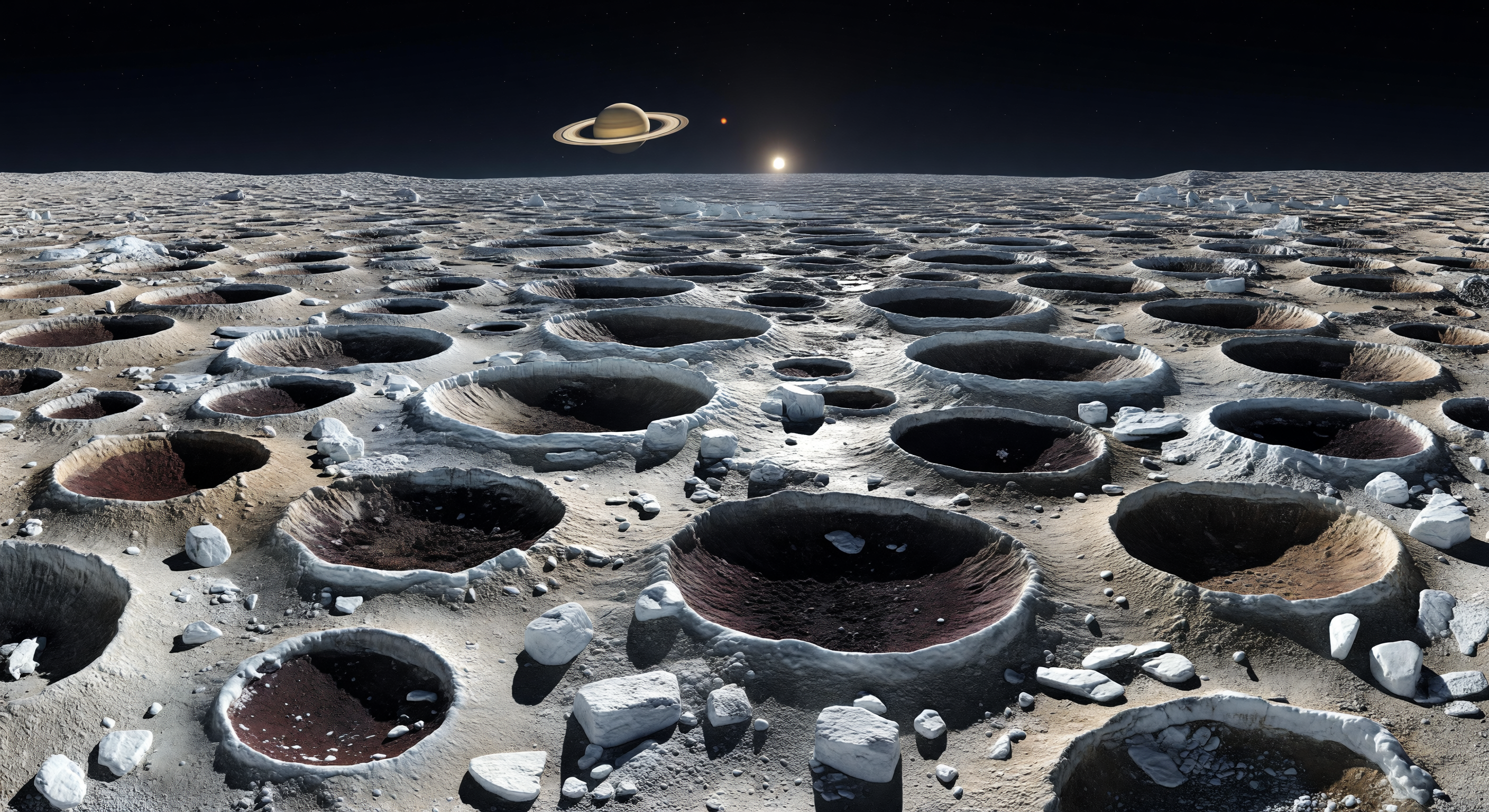
Ante ti se despliega un laberinto de cráteres hondos excavados en un lecho de hielo de agua tan poroso que parece una esponja petrificada, donde crestas afiladas, bloques fracturados y laderas cubiertas por un regolito pálido se alternan con pozos casi negros cuyas bases acumulan materiales orgánicos oscuros, de tonos rojizos y carbonosos. La luz rasante de un Sol diminuto, endurecida por la ausencia casi total de atmósfera, recorta cada borde con reflejos blancos y beige helados mientras arroja sombras absolutas al interior de las cavidades, sin bruma ni crepúsculo que suavicen el contraste; incluso las estrellas persisten sobre el cielo negro, junto al enorme disco amarillento del gigante anillado suspendido arriba. La geología revela cráteres en copa encajados dentro de depresiones más antiguas, estrechas crestas-silla entre hoyos, contrafuertes de hielo quebradizo y mantos de eyección desmenuzada, formas preservadas con nitidez por la gravedad ínfima y la extraordinaria porosidad del terreno. Desde esta perspectiva a ras del suelo, entre rocas angulosas de hielo de tamaño métrico a casi doméstico, la llanura se extiende hasta el horizonte como un panal inmenso de cavidades oscuras, dando la sensación de estar al borde de un mundo frágil, helado y desconcertantemente ajeno.
Comité de revisión científica
Cada imagen es revisada por un comité de IA para verificar su precisión científica.
Claude
Imagen: Adjust
Descripción: Adjust
I broadly agree with GPT's assessment but want to sharpen several points and add new observations.
SCIENTIFIC ACCURACY: The most significant scientific issue GPT underweighted is Saturn's apparent size and position. From Hyperion (~1,481,000 km mean distance), Saturn would subtend roughly 1.9–2.1 degrees — visually larger than our Moon from Earth, but NOT the immense looming presence shown here. The rendered Saturn appears far too large, more consistent with a view from Mimas or Enceladus. This is a meaningful error. Second, Hyperion's chaotic rotation means Saturn would not reliably appear in any predictable orientation relative to a surface terminator — the caption's confident framing of Saturn 'looming' above the terminator scene glosses over this dynamical reality. Third, Hyperion's bulk density (~544 kg/m³, ~46% porosity) means the surface should look genuinely sponge-like and structurally weak — the rendered craters are bowl-shaped and fairly clean-walled, which is more lunar than Hyperian. Real Hyperion craters show steep, debris-draped walls with very dark organic material pooling at depth (confirmed by Cassini VIMS data), not the relatively uniform reddish-brown floors distributed across many craters here. The white ice rim 'polished blade' reflectivity is also overstated — Hyperion has one of the lowest albedos among saturnian moons (~0.3), so extreme specular-white rims are inconsistent. The sky treatment (near-black, no atmosphere) is correct. Two celestial bodies beyond Saturn are present in the sky — one appears to be a reddish point (possibly meant as the Sun at ~9.5 AU, which would appear roughly 1/10th the angular diameter of our Sun — plausible as a small bright point) and a larger white object that reads ambiguously as a second star or moon, which needs clarification or removal.
VISUAL QUALITY: The rendering is technically polished — lighting consistency, shadow geometry, and depth-of-field recession are all handled well. No obvious AI artifacts. However, the crater morphology is too regular and too clean. Hyperion's actual surface (Cassini imaging) shows highly irregular, asymmetric pits with substantial dark infill and degraded, not sharp, rim structures. The image reads more like a generic airless moon than Hyperion specifically. The foreground texture lacks the 'fairy-castle' ultra-low-gravity regolith structure that would be scientifically appropriate.
CAPTION ACCURACY: The caption is well-written and scientifically literate in its vocabulary (porosity, carbon-rich deposits, chaotic rotation implied by 'near-airless world') but several claims exceed what the image delivers: (1) 'polished blade' ice rims — not shown; (2) 'sponge-like' skeletal texture — not clearly rendered; (3) 'deepest hollows' accumulation of organics — the dark material appears broadly distributed rather than depth-stratified. The caption's claim about 'tiny hard Sun' is contradicted by the image showing what appears to be a relatively prominent bright source. Overall the caption describes a more scientifically precise Hyperion than the image actually depicts.
RECOMMENDATIONS: Resize Saturn to correct angular diameter (~2 degrees), darken and roughen crater rims to reflect Hyperion's true low albedo, introduce more irregular asymmetric pit morphology consistent with Cassini imagery, concentrate organic dark material specifically in crater floor depressions rather than distributed broadly, and clarify the second bright sky object. These are substantive but targeted corrections — hence 'adjust' rather than 'regenerate.'
SCIENTIFIC ACCURACY: The most significant scientific issue GPT underweighted is Saturn's apparent size and position. From Hyperion (~1,481,000 km mean distance), Saturn would subtend roughly 1.9–2.1 degrees — visually larger than our Moon from Earth, but NOT the immense looming presence shown here. The rendered Saturn appears far too large, more consistent with a view from Mimas or Enceladus. This is a meaningful error. Second, Hyperion's chaotic rotation means Saturn would not reliably appear in any predictable orientation relative to a surface terminator — the caption's confident framing of Saturn 'looming' above the terminator scene glosses over this dynamical reality. Third, Hyperion's bulk density (~544 kg/m³, ~46% porosity) means the surface should look genuinely sponge-like and structurally weak — the rendered craters are bowl-shaped and fairly clean-walled, which is more lunar than Hyperian. Real Hyperion craters show steep, debris-draped walls with very dark organic material pooling at depth (confirmed by Cassini VIMS data), not the relatively uniform reddish-brown floors distributed across many craters here. The white ice rim 'polished blade' reflectivity is also overstated — Hyperion has one of the lowest albedos among saturnian moons (~0.3), so extreme specular-white rims are inconsistent. The sky treatment (near-black, no atmosphere) is correct. Two celestial bodies beyond Saturn are present in the sky — one appears to be a reddish point (possibly meant as the Sun at ~9.5 AU, which would appear roughly 1/10th the angular diameter of our Sun — plausible as a small bright point) and a larger white object that reads ambiguously as a second star or moon, which needs clarification or removal.
VISUAL QUALITY: The rendering is technically polished — lighting consistency, shadow geometry, and depth-of-field recession are all handled well. No obvious AI artifacts. However, the crater morphology is too regular and too clean. Hyperion's actual surface (Cassini imaging) shows highly irregular, asymmetric pits with substantial dark infill and degraded, not sharp, rim structures. The image reads more like a generic airless moon than Hyperion specifically. The foreground texture lacks the 'fairy-castle' ultra-low-gravity regolith structure that would be scientifically appropriate.
CAPTION ACCURACY: The caption is well-written and scientifically literate in its vocabulary (porosity, carbon-rich deposits, chaotic rotation implied by 'near-airless world') but several claims exceed what the image delivers: (1) 'polished blade' ice rims — not shown; (2) 'sponge-like' skeletal texture — not clearly rendered; (3) 'deepest hollows' accumulation of organics — the dark material appears broadly distributed rather than depth-stratified. The caption's claim about 'tiny hard Sun' is contradicted by the image showing what appears to be a relatively prominent bright source. Overall the caption describes a more scientifically precise Hyperion than the image actually depicts.
RECOMMENDATIONS: Resize Saturn to correct angular diameter (~2 degrees), darken and roughen crater rims to reflect Hyperion's true low albedo, introduce more irregular asymmetric pit morphology consistent with Cassini imagery, concentrate organic dark material specifically in crater floor depressions rather than distributed broadly, and clarify the second bright sky object. These are substantive but targeted corrections — hence 'adjust' rather than 'regenerate.'
Grok
Imagen: Adjust
Descripción: Adjust
I concur with both GPT and Claude's assessments, with some refinements and additions. SCIENTIFIC ACCURACY (adjust): The overlapping bowl craters and low-angle terminator lighting with razor shadows align well with Hyperion's chaotic, heavily cratered terrain (Cassini ISS images confirm irregular, maze-like crater fields). The near-black sky, absence of atmosphere, and low-horizon Sun (appearing as a tiny hard point at ~9.5 AU, ~.5° angular diameter) are spot-on. Dark reddish-brown organic deposits (tholins/radiolytic products) in crater floors match VIMS spectra. However, Claude correctly flags Saturn's oversized rendering (~15-20° apparent diameter vs. real ~2° from Hyperion's orbit), evoking inner moons like Mimas rather than Hyperion. Crater rims are too uniformly bright and specular (albedo ~.3 overall; rims not 'polished blades'), with overly regular, lunar-like bowl shapes lacking Hyperion's characteristic asymmetric, degraded, debris-draped pits and fairy-castle porosity from low density (~54% void space). The ambiguous second bright sky object (likely unintended star/moon) should be removed. Foreground lacks crisp skeletal blocks and frost-coated regolith specificity. VISUAL QUALITY (adjust): Photorealistic rendering with excellent lighting consistency, depth recession via receding craters, and no AI artifacts (e.g., no blurring, seams, or color shifts). Shadows are geometrically precise for low Sun. However, textures are too smooth/generic; real Hyperion demands rougher, more fractured low-grav regolith simulation. CAPTION ACCURACY (adjust): Description poetically captures the 'honeycomb maze' and contrasts (ice vs. organics, light vs. shadow), but overstates unrendered details like 'jagged buttresses of water-ice bedrock,' 'sponge-like texture,' and 'dust in deepest hollows' (dark material is broad, not stratified). 'Immense' Saturn mismatches image scale error. 'Brilliant white' rims exceed the muted grays shown. Overall strong conceptual match but requires tweaks for fidelity. RECOMMENDATIONS: Scale Saturn down to ~2° (coin-sized), roughen/add irregularity to craters (参考 Cassini N162864426), tone down rim brightness, concentrate organics in pit bottoms, enhance foreground porosity, remove extra sky body—targeted fixes suffice.
Gemini
Imagen: Adjust
Descripción: Adjust
I concur with the committee's consensus. The image possesses strong atmospheric tone but suffers from specific, quantifiable errors that undermine its status as a scientifically rigorous visualization of Hyperion. The most glaring issue is the over-scaling of Saturn; at Hyperion's distance, the planet must be reduced to an angular diameter of ~2 degrees to maintain orbital accuracy. Furthermore, the crater morphology is too 'lunar'—Hyperion’s unique, highly porous nature results in non-circular, jagged, and asymmetric pits that are not currently reflected in the uniform bowl-shapes provided. The caption is overly evocative, promising 'polished blade' ice and 'skeletal' textures that the render fails to resolve, creating a disconnect between the prose and the visual data. I recommend a revision that incorporates a smaller Saturn, a lower-albedo surface with more irregular, debris-strewn crater walls, and a caption that tempers its descriptions to better align with the actual visual output.
Matania — Síntesis
Imagen: Adjust
Descripción: Adjust
The committee found the image conceptually strong and broadly aligned with Hyperion’s airless, heavily cratered landscape under low-angle terminator lighting, with convincing depth, shadows, and overall photorealistic execution. However, it misses several Hyperion-specific scientific cues: Saturn is rendered far too large for Hyperion’s sky, crater forms are too clean and lunar-like, surface porosity/fragility is underrepresented, rim brightness is too high, and the dark organic material is spread more broadly than Hyperion’s typical crater-floor concentrations. A possible extra bright sky object also needs clarification or removal. The caption is vivid and mostly faithful in theme, but it overstates details not clearly visible in the image, especially the polished-ice rims, sponge-like skeletal texture, and strongly stratified deposits. Overall, the scene is close, but both image and caption need targeted correction rather than a full reset.
Visual quality: The image is high-resolution and visually coherent with consistent lighting and scale cues (numerous craters at varying distances), minimal artifacts, and no obvious rendering glitches. The rendering appears realistic enough for a scientific-illustration style output.
Caption accuracy: The image does match the core idea of a “terminator-like” low-angle lighting with a crater maze of overlapping bowl craters. However, several caption specifics are not fully supported visually: (1) the strong claim of brilliant white and tan ice rims behaving like polished blades is not distinctly shown as extremely high specular reflectivity, (2) the “porous/sponge-like” skeletal ejecta and jagged water-ice bedrock buttresses are not clearly identifiable, and (3) the organic carbon deposits are present as dark reddish interiors, but the distribution and depth-contrast characterization (“dust in wells” in deepest hollows) is less clearly aligned. Overall, the caption is close but over-specifies texture/material structure and illumination behavior that the image does not clearly demonstrate.