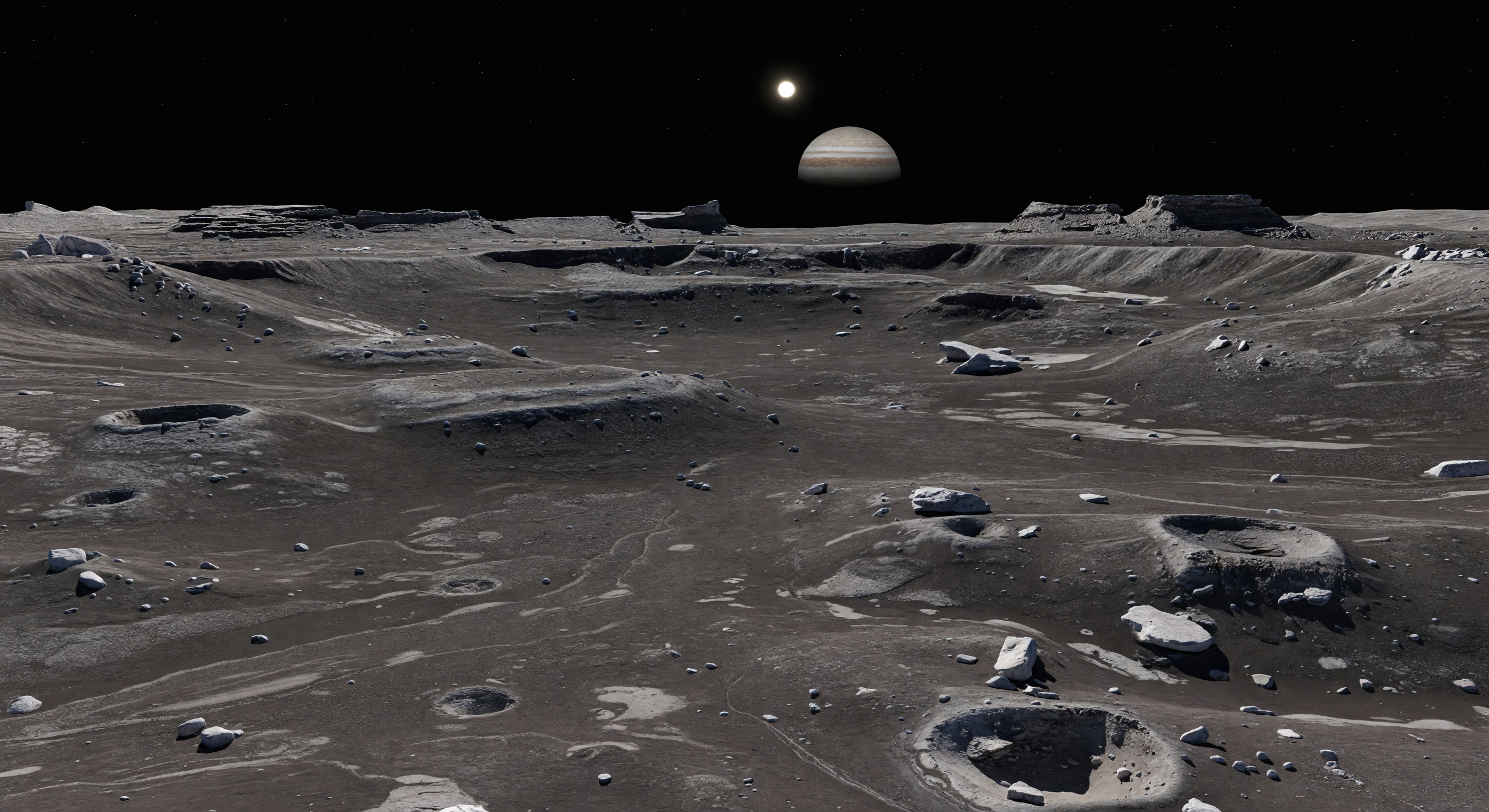
Desde el suelo de esta cuenca de impacto antiquísima, el paisaje se abre como una llanura inmensa y amortiguada de regolito helado marrón grisáceo y carbón apagado, donde hielo de agua sucio, polvo rico en silicatos y brechas de antiguos choques forman una superficie ondulada, salpicada por pequeños montículos, terrazas concéntricas suavizadas, zanjas someras y bloques angulosos de hielo y roca. Todo aquí habla de una edad extrema: cráteres menores medio sepultados, finas vetas pálidas de eyección y escarpes lejanos redondeados por eones de jardinería de impactos y lenta relajación viscosa del hielo, no por volcanismo, ríos ni atmósfera, porque no hay clima ni procesos activos que renueven el terreno. La luz de un Sol pequeño y feroz cae con un blanco frío, recortando sombras negras y nítidas bajo cada roca, mientras el vacío mantiene el horizonte con una claridad casi antinatural y deja que, sobre los restos del borde remoto, se alce el enorme disco bandeado de Júpiter en un cielo completamente negro. Las diminutas piedras del primer plano frente a las terrazas espaciadas a escala kilométrica y a los fragmentos del borde que se pierden hasta el horizonte revelan la verdadera magnitud de esta depresión fantasma: un cráter colosal tan antiguo y apaciguado que parece más una cicatriz fósil del Sistema Solar que un paisaje vivo.
Comité de revisión científica
Cada imagen es revisada por un comité de IA para verificar su precisión científica.
Claude
Imagen: Adjust
Descripción: Adjust
I largely concur with GPT's assessment but want to add several specific observations and one disagreement.
SCIENTIFIC ACCURACY: The terrain rendering is broadly defensible for Callisto. The dark gray-brown regolith palette, the absence of any atmospheric haze, the hard black shadows from a small distant sun, and the cratered, heavily gardened surface are all consistent with what we know from Galileo mission imagery. The mixture of bright angular blocks (likely ice-rich ejecta) against darker dusty matrix is actually a genuine strength here—Callisto's surface does show this bimodal texture. I want to specifically DISAGREE with GPT's characterization that this reads as 'uniform dusty regolith'; there is visible albedo variation and block heterogeneity that reasonably approximates Callisto's actual surface character. However, I flag one accuracy concern GPT underweighted: the topographic relief appears somewhat too dramatic for a ghost basin floor. Ghost basins on Callisto (like Valhalla's interior zones) are specifically notable for viscous relaxation having nearly obliterated relief—the undulations here read more like a young lunar mare than a maximally relaxed ancient impact structure. The distant massifs are appropriately rendered as sharp-edged in a vacuum, which is correct. Regarding Jupiter: at Callisto's actual orbital distance (~1.88 million km), Jupiter would subtend roughly 1.8–2 degrees of arc—noticeably large but not dominating the sky. The rendered Jupiter appears close to this angular size, which is actually more scientifically defensible than the caption's 'huge banded Jupiter' language implies. The bands are faintly visible, which is realistic given atmospheric seeing wouldn't apply in vacuum but the distance still limits detail. The Sun being rendered as a small brilliant point-source near Jupiter is appropriate for the Jovian system.
VISUAL QUALITY: The image is high photorealistic quality. Lighting consistency is good—shadow directions across boulders, crater walls, and regolith surfaces appear coherent with a single distant light source. No obvious AI artifacts such as impossible geometry or texture smearing are detectable. The crater morphology—particularly the shallow, flat-floored depressions in the foreground—is well-executed. One minor quality issue: some of the white/bright boulder surfaces read as almost too specular-clean, whereas Callisto's surface materials are heavily darkened by radiation processing and micrometeorite gardening; pristine bright ice faces would be rare and small.
CAPTION ACCURACY: The core geological description is strong and mostly reflected in the image—the ghost basin context, impact gardening, softened topography, angular boulders in fine ejecta, distant rim fragments, and black sky are all present. The caption's claim of 'razor-sharp' distant rim fragments is verified in the image and correctly attributed to vacuum conditions. The main caption overclaim is 'a huge banded Jupiter'—the image shows a moderately sized Jupiter that is scientifically more accurate than the caption suggests, meaning the caption oversells what would actually be seen. The description of 'shallow troughs' is weakly supported; the linear features visible are subtle and could as easily be interpreted as erosion patterns. 'Softened terraces' are marginally visible but not clearly terraced. Recommend adjusting the caption's Jupiter description to better match both the image and orbital reality, and moderating the topographic relief claims to better reflect ghost basin viscous relaxation character.
SCIENTIFIC ACCURACY: The terrain rendering is broadly defensible for Callisto. The dark gray-brown regolith palette, the absence of any atmospheric haze, the hard black shadows from a small distant sun, and the cratered, heavily gardened surface are all consistent with what we know from Galileo mission imagery. The mixture of bright angular blocks (likely ice-rich ejecta) against darker dusty matrix is actually a genuine strength here—Callisto's surface does show this bimodal texture. I want to specifically DISAGREE with GPT's characterization that this reads as 'uniform dusty regolith'; there is visible albedo variation and block heterogeneity that reasonably approximates Callisto's actual surface character. However, I flag one accuracy concern GPT underweighted: the topographic relief appears somewhat too dramatic for a ghost basin floor. Ghost basins on Callisto (like Valhalla's interior zones) are specifically notable for viscous relaxation having nearly obliterated relief—the undulations here read more like a young lunar mare than a maximally relaxed ancient impact structure. The distant massifs are appropriately rendered as sharp-edged in a vacuum, which is correct. Regarding Jupiter: at Callisto's actual orbital distance (~1.88 million km), Jupiter would subtend roughly 1.8–2 degrees of arc—noticeably large but not dominating the sky. The rendered Jupiter appears close to this angular size, which is actually more scientifically defensible than the caption's 'huge banded Jupiter' language implies. The bands are faintly visible, which is realistic given atmospheric seeing wouldn't apply in vacuum but the distance still limits detail. The Sun being rendered as a small brilliant point-source near Jupiter is appropriate for the Jovian system.
VISUAL QUALITY: The image is high photorealistic quality. Lighting consistency is good—shadow directions across boulders, crater walls, and regolith surfaces appear coherent with a single distant light source. No obvious AI artifacts such as impossible geometry or texture smearing are detectable. The crater morphology—particularly the shallow, flat-floored depressions in the foreground—is well-executed. One minor quality issue: some of the white/bright boulder surfaces read as almost too specular-clean, whereas Callisto's surface materials are heavily darkened by radiation processing and micrometeorite gardening; pristine bright ice faces would be rare and small.
CAPTION ACCURACY: The core geological description is strong and mostly reflected in the image—the ghost basin context, impact gardening, softened topography, angular boulders in fine ejecta, distant rim fragments, and black sky are all present. The caption's claim of 'razor-sharp' distant rim fragments is verified in the image and correctly attributed to vacuum conditions. The main caption overclaim is 'a huge banded Jupiter'—the image shows a moderately sized Jupiter that is scientifically more accurate than the caption suggests, meaning the caption oversells what would actually be seen. The description of 'shallow troughs' is weakly supported; the linear features visible are subtle and could as easily be interpreted as erosion patterns. 'Softened terraces' are marginally visible but not clearly terraced. Recommend adjusting the caption's Jupiter description to better match both the image and orbital reality, and moderating the topographic relief claims to better reflect ghost basin viscous relaxation character.
Grok
Imagen: Adjust
Descripción: Adjust
I concur with both GPT and Claude on the core strengths and issues but add targeted refinements. SCIENTIFIC ACCURACY (adjust): Terrain captures Callisto's signature dark, heavily gardened regolith (dark taupe-gray/charcoal tones from silicate dust and irradiated ice), angular half-buried boulders, and subdued undulations from impact gardening/viscous relaxation—consistent with Galileo imagery of ghost basins like Asgard or Valhalla interiors. Black sky, hard shadows from tiny Sun (visible as small white point), and vacuum-sharp distant massifs/rim fragments are spot-on. Bimodal albedo (darker matrix + brighter blocks) aligns with real ice-breccia ejecta, supporting Claude's disagreement with GPT on texture uniformity. Jupiter's angular size (~1.8° at 1.88M km) is realistically rendered as a moderately sized disk with faint bands near the horizon (not 'huge' as caption claims, but accurate vs. Galileo's views). Minor issue: foreground relief (hummocks, troughs) slightly exceeds maximal viscous relaxation for true ghost basins, reading more fresh-cratered than anciently relaxed (Claude's valid point). No atmosphere or resurfacing errors. VISUAL QUALITY (approve, minor adjust implied): Excellent photorealism—coherent single-source lighting (shadows align across boulders, slopes, Sun position), detailed regolith textures without AI artifacts (no smearing, impossible geometry), natural boulder embedding. Slight over-brightness on some ice faces (Claude noted); tone down specularity for radiation-darkened realism. CAPTION ACCURACY (adjust): Description nails geology (undulating plain, hummocks/terraces/troughs, boulders in ejecta, distant sharp rims, black sky, hard Sun glints) and processes (no water/volcanism, impact gardening, viscous relaxation), all visually present. Mismatches: 'Huge banded Jupiter hanging low' oversells size/banding prominence (image shows smaller, subtler Jupiter, more accurate); 'softened terraces/shallow troughs' present but subdued, not dominant; scale/desolation deepened by Jupiter but less dramatically. Constructive: Adjust image for flatter relief, subtler ice specularity; revise caption to 'prominent banded Jupiter low on horizon' and 'subtle softened terraces/troughs' for alignment with reality/image.
Gemini
Imagen: Adjust
Descripción: Adjust
I concur with the committee's consensus. The image represents a high-fidelity attempt at Callisto’s unique geomorphology, particularly the dark-to-bright bimodal albedo of the regolith. However, the 'ghost basin' classification necessitates a more pronounced 'softening' of topography; the current foreground hummocks and boulders suggest a younger, fresher impact site than the term 'ghost basin' implies. Regarding the Jupiter discrepancy, the image is physically more accurate than the caption's description of a 'huge' planet, but the caption should be revised to reflect the actual angular size of Jupiter as seen from Callisto to ensure scientific precision. I agree that the specularity of the ice faces is slightly excessive; Callisto’s surface is notoriously dark due to long-term radiation processing, and the 'glints' should be more muted to reflect this. The caption should be adjusted to be more restrained regarding the scale of the planetary features and the prominence of the terraces, while the image needs a slight reduction in the sharpness of foreground relief to better align with the viscous relaxation characteristic of ancient crater floors.
Matania — Síntesis
Imagen: Adjust
Descripción: Adjust
The committee agrees the image is a strong, photorealistic depiction of Callisto-like terrain: dark, heavily gardened regolith; scattered angular boulders; a black vacuum sky; crisp shadows; and distant rim/massif fragments all fit the target moon well. The main scientific issue is that the ghost-basin floor still feels a bit too rugged and high-relief, reading slightly younger than a maximally relaxed ancient basin. Jupiter is also depicted more modestly and plausibly than the caption implies, with faint banding rather than a huge dominant presence. There is a minor concern that some bright ice faces are a bit too clean/specular for Callisto’s radiation-darkened surface. Overall, both image and caption are close, but each needs refinement to better match the actual geometry and planetary scale expected at Callisto.
Visual quality: The image is high-quality and largely photorealistic in style—credible terrain rendering, consistent horizon/illumination, and no obvious compositing artifacts. Rock shapes and shadow directions appear consistent. The main visual mismatch is atmospheric/astronomical context (Jupiter presentation vs. the caption’s “banded banded Jupiter deepens the sense of scale”), rather than any rendering defect.
Caption accuracy: Many elements align—Callisto-like dark undulating floor, shallow trough-like depressions, scattered boulders, and distant crater/rim remnants under a black sky with hard sunlight. But the caption’s specific astronomical portrayal (huge banded Jupiter low above the horizon) is not reflected in the image, where Jupiter appears much smaller and less band-emphasized. Additionally, the caption’s emphasis on “softened terraces” and “shallow troughs” is partially present but not as clearly/structurally defined as stated.
Overall: Recommend minor adjustment—keep the Callisto ghost-basin/impact-gardening tone, but correct the Jupiter depiction and slightly soften the claims about distinct terrace/trough/ice-breccia textures unless they are explicitly visible.