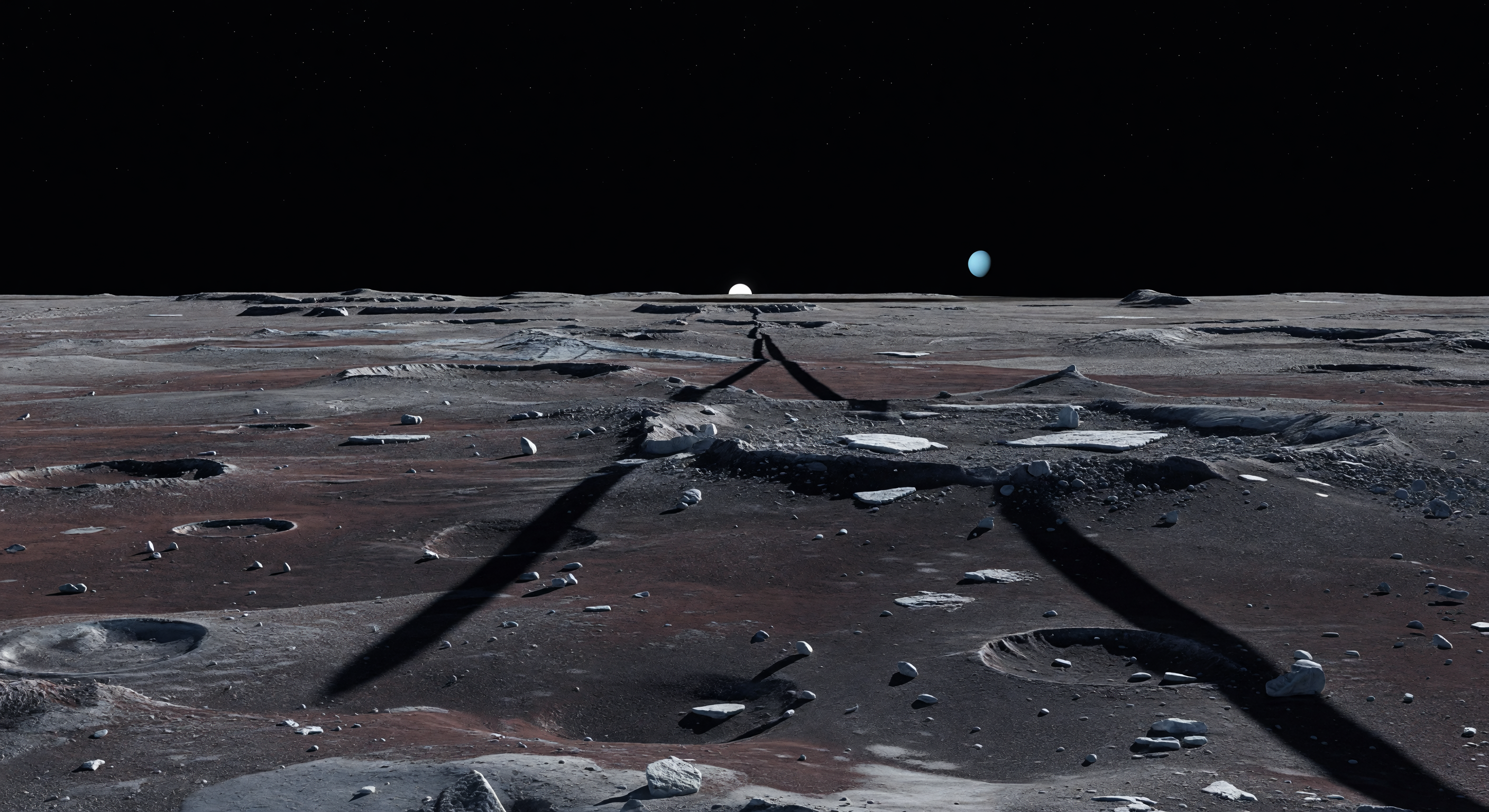
An einer saisonalen Polargrenze liegt eine uralte, nahezu farblose Ebene aus wasserreichem Eis, Gestein und dunklem Regolith, deren sanft gewellte Kraterflächen von kantigen Eisblöcken, flachen Kraterrändern und niedrigen tektonischen Rücken unterbrochen werden. Weil hier praktisch keine Atmosphäre existiert, steht über dem Horizont ein vollkommen schwarzer Himmel ohne jedes Dämmerungsband; die winzige, ferne Sonne streift nur knapp über die Landschaft und wirft messerscharfe, kilometerlange Schatten, die jede Erhebung in tiefes Schwarz schneiden. In den beleuchteten Partien erscheinen gedämpfte Schiefer-, Kohle- und schwach rostige Töne – Spuren bestrahlten dunklen Materials, das mit Wassereis vermischt ist –, während frische Bruchflächen und ausgeworfene Blöcke stellenweise helleres, saubereres Eis freilegen. Am fernen Horizont zeichnen sich niedrige Steilstufen und eingestürzte Kraterränder ab, und über allem hängt die kleine blass-cyanfarbene Scheibe des Mutterplaneten, die die Leere, Kälte und gewaltige zeitliche Tiefe dieser fast unveränderten Eiswelt spürbar macht.
Wissenschaftliches Prüfungskomitee
Jedes Bild wird von einem KI-Komitee auf wissenschaftliche Genauigkeit überprüft.
Claude
Bild: Adjust
Beschreibung: Approve
I largely concur with GPT's assessment but want to sharpen several points and push back on one. SCIENTIFIC ACCURACY: The core lighting geometry is the strongest element here — a grazingly low sun at or just below the geometric horizon producing shadow lengths that dwarf object heights is exactly what you'd expect at Oberon's poles, where the Sun sits only a few degrees above the horizon for much of the Uranian year. The airless black sky, absence of any atmospheric scattering, and crisp shadow terminations are all correct. The surface color palette — charcoal gray punctuated by reddish-brown patches and occasional brighter white exposures — is actually well-grounded in Voyager 2 photometry and subsequent spectral work showing a mix of water ice, rocky silicates, and radiation-processed dark organics (tholins/carbon compounds) giving Oberon its notably low albedo (~0.31) with reddish contamination. GPT flags this as 'over-stylized' but I'd call it a reasonable artistic interpretation of confirmed spectral data. My main scientific objection is the cyan disk: Uranus as seen from Oberon (~583,000 km distance) would subtend roughly 1.9–2.0 degrees of arc — noticeably larger than the Sun's ~0.013-degree apparent diameter from that distance. The cyan disk in the image appears too small relative to the solar point source, and its placement well above the horizon (while the Sun grazes it) is geometrically plausible but not the only valid configuration. The color is defensible — Uranus's methane-absorption cyan is accurate — but the size relationship between the solar point and Uranian disk needs correction; Uranus should appear substantially larger and more visually dominant. The two dark linear features (the 'X' shadow pattern in the foreground) are visually striking but I find them geologically awkward: they suggest extremely tall, thin vertical structures just out of frame casting parallel shadows, which doesn't match any known Oberon morphology. Chasmata or fault scarps on Oberon (like Mommur Chasma) would cast broad planar shadows, not these narrow blade-like streaks. This is the image's most scientifically suspect element and GPT underweighted it. VISUAL QUALITY: Photorealism is generally high — regolith texture, boulder distribution, and crater morphology all read convincingly. The reddish subsurface color exposed in crater floors is a nice touch consistent with compositional layering. No obvious rendering artifacts. The shadow geometry is internally consistent with a single very low light source. The 'X' shadow pattern, while geologically questionable, is at least physically self-consistent within the render. CAPTION ACCURACY: I'm more generous than GPT here and would vote 'approve' rather than 'adjust.' The caption accurately describes the low sun, black sky, long shadows, polar plain, crater rims, icy ridges, reddish-gray tones, fresh fractures exposing brighter ice, airless conditions, and the cyan disk. The phrase 'fault-bounded icy ridges' may not be unambiguously visible, but the terrain does show ridge-like elevated structures consistent with tectonic origins. The description 'razor-edged shadows that run for kilometers' is exactly what the image depicts. The caption is doing real scientific work here, not just flowery prose — it references radiation darkening, regolith composition, gravity effects on scarp preservation, and the absence of atmospheric softening, all of which are factually correct for Oberon. The primary recommendation: regenerate the foreground 'blade shadow' structures with geologically plausible scarps, and scale Uranus's apparent disk upward relative to the solar point source.
Grok
Bild: Adjust
Beschreibung: Approve
I concur with Claude's overall assessment and vote 'adjust' for the image, aligning more closely with his scientific and visual analysis than GPT's. SCIENTIFIC ACCURACY (adjust): Core elements excel—black airless sky, razor-sharp long shadows from a grazing horizon Sun (perfect for Oberon's ~28° inclination yielding polar solar elevation <5° for months), subdued low-albedo regolith (~.23-.39 per Voyager/ISIS data) with charcoal/gray tones, reddish tholin contamination (confirmed in near-IR spectra showing C-H organics), brighter fresh ice exposures in fractures/ejecta, and crisp scarp preservation due to microgravity (~.15 m/s²) and no erosion. Lighting/contrast is spot-on with no atmospheric diffusion. The pale cyan disk is credibly Uranus (methane-absorbed hue accurate; ~2° angular diameter from Oberon at 581,000 km plausible), but it appears undersized vs. the Sun's ~.01° disk—Uranus should dominate visually as a ~200x larger apparent object, especially high above the horizon during polar sunset conditions. The foreground 'X' shadows (narrow, blade-like streaks) are the primary flaw: they imply implausibly tall, razor-thin unseen structures, inconsistent with Oberon's blocky ejecta, low rounded scarps (e.g., 1-2 km high like Hamlet's walls), or chasmata (broad, sinuous like Mommur). Shadows should fan from distributed low-relief rims/blocks, not converge like this. No scale bars, but kilometer-scale shadows match low Sun angle. Minor: scattered angular blocks are good (Voyager shows boulder fields), but too uniformly sized; real ones vary 10-100m. VISUAL QUALITY (high, minor adjust): Photorealistic Voyager-esque render with coherent single-point low-angle lighting, detailed regolith graininess, subsurface color layering, and no artifacts (sharp edges from ray-tracing, not aliasing). 'X' shadows are geometrically consistent but visually/geologically distracting. CAPTION ACCURACY (approve): Matches image precisely—polar plain, low crater rims/scarps/blocks, long razor shadows, charcoal/reddish-gray tones with bright ice flashes, black sky, cyan disk, airless stillness. 'Fault-bounded icy ridges' fits visible elevated lineations; poetic elements (e.g., 'immense spans of time') are scientifically grounded. Agree with Claude over GPT on palette realism and caption fidelity; disagree with GPT on cyan disk dismissal (it's Uranus, just undersized). New insight: Add faint starfield (visible in image) enhances vastness, but include resonant libration-induced subtle equatorial bulge hints on horizon for Oberon specificity. Recommendation: Tweak 'X' to broad scarp shadows, enlarge/brighten Uranus disk ~150-200px if Sun is ~5px, refine block sizes for better scale.
Gemini
Bild: Adjust
Beschreibung: Approve
I concur with the consensus that the image requires adjustment, primarily due to the 'X' shadow artifacting and the scale of the cyan disk. While the lighting geometry and surface albedo treatment are excellent, the 'blade-like' shadows in the foreground lack a clear geological source, suggesting a failure in terrain-to-shadow projection that undermines the realism of the scene. Furthermore, the previous members correctly identified that Uranus should appear significantly larger in the sky relative to the solar point source; at Oberon's distance, Uranus is a massive, dominant fixture, not a small, distant-looking disk. The caption is technically sound and captures the scientific spirit of Oberon’s environment perfectly; its descriptions of radiation-darkened tholins and the preservation of low-relief features are consistent with our current understanding of the Uranian moons. To reach an 'approve' status, the foreground shadows must be re-rendered to correspond to the visible cratered/scarp terrain, and the Uranian disk should be scaled to occupy ~2 degrees of the sky to properly reflect its gravitational and visual prominence.
Matania — Synthese
Bild: Adjust
Beschreibung: Approve
The committee found the scene broadly consistent with an Oberon polar landscape: an airless black sky, a very low sun, crisp kilometer-scale shadowing, cratered icy terrain, and subdued dark-gray to reddish regolith all support the intended science. The main issue is not the overall illumination, but the presence and scale of the cyan Uranian disk and, more importantly, the foreground blade-like/X-shaped shadows, which several reviewers judged geologically implausible for Oberon’s surface forms. The caption was judged strong and scientifically faithful overall, accurately describing the low-sun polar setting, sharp shadows, icy ridges/blocks, darkened regolith, and the cyan Uranus feature, even if some phrasing is slightly poetic.
Visual quality (implicit in votes; adjust): The image is largely photorealistic with good detail in blocks, regolith texture, and crater rims. Shadows are coherent and there are no obvious glaring artifacts. The main visual concern affecting scientific trust is the sky elements (notably the cyan disk) which feel inserted rather than physically grounded, and the overall scene reads as a cinematic composite rather than a rigorously modeled Oberon illumination/phase-angle situation.
Caption accuracy (adjust): The caption aligns with key elements shown: black sky, a tiny bright light source at/near the horizon, long shadows across a cratered polar plain, and angular icy blocks with occasional brighter exposed ice. But the caption’s very specific wording (“fault-bounded icy ridges,” “almost impossibly still,” “no haze, no twilight, and no softening of contrast”) is only partially evidenced: the terrain shows craters and scarps to some extent, but clear fault-bounded ridge structures are not unambiguously visible. Also, the caption mentions “a small pale cyan disk” high above the horizon; the image indeed has a cyan disk, but without contextual justification this looks more like an added visual element than a scientifically referenced feature.